A Titanic Fluff Up

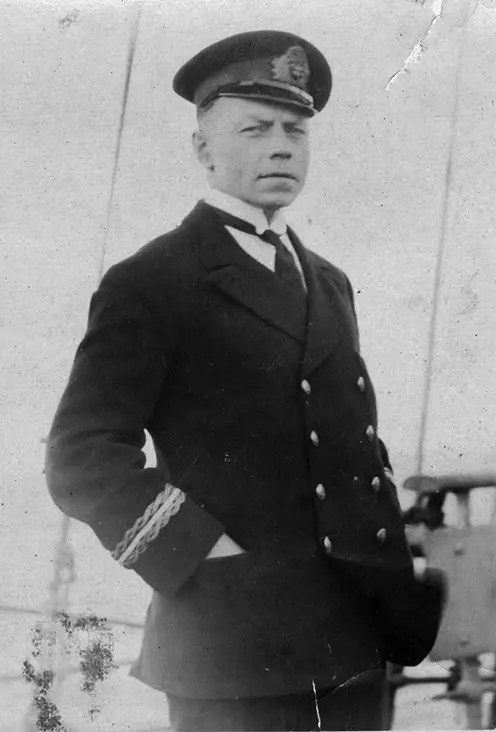
Herbert John Pitman (1877 – 1961) was Third Officer of the Titanic on her final voyage. I stumbled across his Wikipedia article yesterday and was struck by a number of things. One is the photo: he has a white stripe between his gold braid, which I thought was slightly odd for a Third Officer. In the Royal Navy a white stripe or insert signified the Accountant Branch, and for the merchant service it was the same: apparently after surviving the Titanic disaster Pitman transferred to the purser line because of colour blindness, which must have been a cruel blow to a man in his 30s.

In his infobox it was claimed that he was an Acting Paymaster who served in the Royal Naval Volunteer Reserve from 1916 to 1919. In the text it stated: ‘During World War I, Pitman served aboard troop transport ships, notably aboard RMS Teutonic as Assistant Paymaster. In 1916, he received a commission as Lieutenant in the Royal Naval Volunteer Reserve and served as Stores Officer aboard a destroyer. In 1919, he was demobilised and returned to the Merchant service.’

Perhaps unsurprisingly, this is all drivel. Mercantile marine officers, because of their actual professional experience, usually became officers in the Royal Naval Reserve, and not the Royal Naval Volunteer Reserve. Pitman was no different, becoming an Temporary Assistant Paymaster in the Royal Naval Reserve on 12 September 1914. At some point in 1917 he became an Acting Paymaster, which at the end of 1918 was renamed Paymaster Lieutenant. He spent the entire war in the Teutonic, so I fail to see how he could have been in destroyers. He was still on the list of RNR officers in April 1919 but disappears by July. Perhaps because of the wartime nature of his service he has no digitised service records at The National Archives.

Naturally, this crime against history has now been fixed.

Going Home

And now, for something completely different. But still involving research. A couple of weeks ago I stayed at a hotel on the outskirts of Lincoln for work. My father was born and raised there, and his parents lived there until my grandfather died in 1990, and then my grandmother moved to Cumbria to be near us. Despite being only four or possibly five years old when I had last visited, I still remembered an astonishing amount about the house. It was what is apparently called a ‘chalet bungalow’. I could recall on the ground floor a dining room, a kitchen (yellow with decades of cigarette smoke), the main bedroom, the living room, and a large hall. Upstairs was a spare room at one end where my brother and I stayed. Presumably there was another spare room up there where my parents were put.

Whilst relaxing in the hotel after a hard day’s work, I thought I would try and find out where the house was. My father sadly died in 2021 (the same age as his father, oddly enough) so I couldn’t ask him, and my mother died 25 years before him. I loaded up the British Newspaper Archive to try and track my grandparents down, especially since my grandfather had the relatively unusual name of Edgar. Owing to the vagaries of the BNA website, the only address I could track down at first was the death notice my father had put in the Lincolnshire Echo for my grandmother, thoughtfully putting the street name in it—Eastbrook Road—but no house number. It was a start.

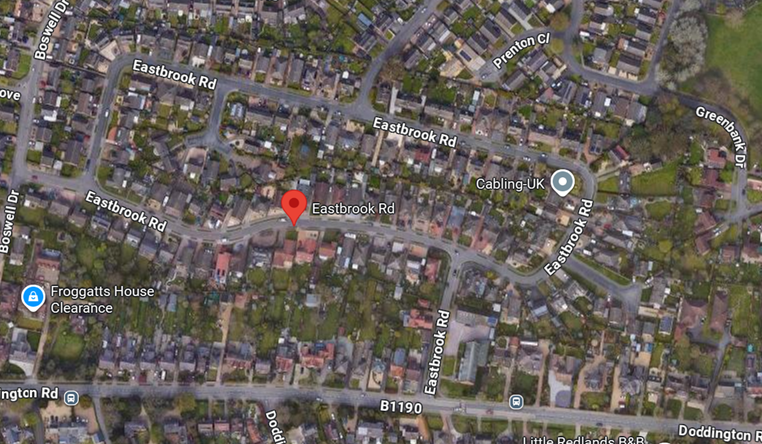
I then went to Google Maps, and found Eastbrook Road was a long circular road. Not very helpful. I suppose I could gave just gone on Street View until I found something familiar, but I wanted to do it the relatively hard way. One other detail I remembered from my childhood was that at the bottom of what seemed to be a gigantic garden some houses had been built over the time that we visited. Looking at the map it seemed that most of the surrounding streets were more of the same mishmash of post-war detached houses, apart from one area: Greenbank Drive to the east. So I went to Street View for that corner of Eastbrook Road and found number 65, looking just like my grandparents house.

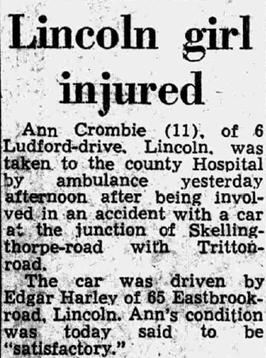
How to make sure though? I tried the British Newspaper Archive again and put in ’65 Eastbrook Road’, and the result was moderately surprising. An article about Edgar Harley of 65 Eastbrook Road knocking down an 11 year old girl in his car! Evidently the article hadn’t been OCRed very well. Confirmation obtained, albeit at the cost of yet another question raised about my family!

It turned out that 65 Eastbrook Road was less than ten minutes away, so I went off, not knowing what to expect. I suppose it turned out as well as it could: the house was for sale. No blinds or curtains obscured the windows. No car filled the driveway. Bottom left was the dining room. Top right was where the guest room I’d stayed in as a boy. Bottom right was a room I had no recollection of whatsoever, unless the old living room had been split into two. The driveway outside the garage had some distinctively coloured paving slabs I recognised from many old photographs in albums featuring family members and dogs.

This may all seem very trivial, but I am absolutely amazed that someone under the age of five could remember so many details. Unsurprisingly, it was rather an odd feeling being back there for the first time in 35 years. What else could it be? All the more odd on being met by a house which was literally just a shell. Apart from white paint and grey carpets it could have been the same as when my grandmother moved out. A homecoming of sorts, but one which took about 45 minutes of my day all told, including research. I’m glad I went.

What’s in a Year?

It may be remembered that back in 2022 I pointed out a rather obvious flaw in the new introduction to an old book reprinted by Seaforth. Today I was looking at The Royal Navy Officer’s Jutland Pocket-Manual 1916, a cretinously-named 2016 cash in (I’m sorry, reprint) of New Battleship Organisations by Commander (later Admiral Sir) William M. James. Cretinously-named, as it has bugger all to do with Jutland, and the original book definitely wasn’t pocket sized (my own copy belonged to Vice-Admiral Sir Stuart Bonham Carter, a lieutenant who served in the Emperor of India for most of the war, and distant relative of Helena). A new introduction was written by Brian Lavery, described as ‘one of the foremost historians of the Royal Navy’. At the beginning of this introduction we are informed that James ‘entered the navy at the age of 13 by the training ship Britannia in 1895′.

A slight problem. He was 14 and he entered the training ship in 1896.

The publisher of The Royal Navy Officer’s Jutland Manual, and the commissioner of this introduction? None other than Seaforth’s Pen & Sword stablemate, Casemate Publishers. Does anyone proof-read this stuff?

Inquest in the Snug

And now, for something completely different. My attention was drawn yesterday to a 2023 lecture from the then Chief Coroner of England and Wales, Thomas Teague, K.C., who said:

Now, you will find it confidently asserted by various authorities that it was abolished by the Coroners Act of 1887. That is not so. The 1887 Act was completely silent about it. The earliest prohibition I have been able to find is contained in section 21 of the Licensing Act 1902, which forbade coroners to use public houses for inquests ‘where other suitable premises have been provided’. Section 21 was repealed in 1910 and I cannot trace any successor to it, raising the tantalising possibility that there currently exists no legal prohibition – not even a qualified one – against holding inquests in pubs. If so, it occurs to me that I might, perhaps, consider issuing some measured guidance on the topic.

Section 21 read:

From and after the thirty-first day of March one thousand nine hundred and seven, no meeting of justices in petty or special sessions shall be held in premises licensed for the sale of intoxicating liquors, or in any room, whether licensed or not, in any building licensed for the sale of intoxicating liquors; nor shall any coroner’s inquest be held on such licensed premises, where other suitable premises have been provided for such inquest.

It was indeed repealed by the Licensing (Consolidation) Act, 1910, so Teague’s claim that ‘Section 21 was repealed in 1910’ was accurate. Unfortunately, he apparently did not read the rest of the act, as section 83 reads:

No meeting of justices in petty or special sessions shall be held in licensed premises, or in any room, whether licensed or not, in any building licensed for the sale of intoxicating liquors; nor shall any coroner’s inquest be held on any such licensed premises where other suitable premises have been provided for the inquest.

The qualified prohibition was copied nearly word for word in 1910 act! And thanks to the wonder of Google Books, one finds a similar section in the Licensing Act, 1953:

157.—(1) Licensed premises, or a room in a building part of which is licensed premises, shall not be used as a petty-sessional court-house or an occasional court-house.

(2) A general annual licensing meeting or transfer sessions or special sessions shall not be held in licensed premises or in any such room as aforesaid.

(3) A coroner’s inquest shall not be held in licensed premises or in any such room as aforesaid if any other suitable place is provided.

Section 157 subsection 3 was not amended or repealed by the Licensing Act, 1961 (but subsections 1 and 2 were). The Licensing Act 1964, section 190, subsection 3, reads:

A coroner’s inquest shall not be held in licensed premises or in a room in a building part of which is licensed premises, if any other suitable place is provided.

The 1964 act was repealed in its entirety by the Licensing Act 2003, schedule 7. I don’t know if the holding of inquests in licensed premises was specifically barred or qualified by another piece of legislation, but it would seem that the qualified permission granted by previous acts has definitely disappeared. It is fascinating to note that magistrates were barred from holding sessions on licensed premises by 31 March 1907 at the latest!

Beer and Sex

I was idly reading an article the other day and came across a very odd claim, the source of which was page 46 of Keith Yates’ 2000 book Flawed Victory: Jutland, 1916, published by Naval Institute Press:

The German ships on the other hand were equipped with up to seven three-meter Zeiss stereoscopic range finders that were positioned at different points in the ship. The values obtained were then averaged mechanically. The stereoscopic devices gave more accurate values, especially for blurred images of the enemy ship, as might be the case under battle conditions due to interference from smoke or mist. As with the gunlayers, the problem was again that the German system placed too great a reliance on the skill and training of individual operators. They had to have perfect vision in both eyes and needed long periods of training. They were even ordered to abstain from beer and sex while preparing to go to sea.

From where did Yates find that last nugget of information regarding beer and sex? He does not say. In the foreword (p. x) we are informed:

The book is aimed intentionally at the general reader with an interest in naval history, like myself. For this reason I have not included any footnotes in the text, because these tend to distract the average reader from the flow of the narrative. Nonetheless, I hope the book will be regarded as a worthwhile reassessment of this intriguing battle and its equally fascinating aftermath.

Can you tell that Yates was a chemistry academic and not a historian? He also made the embarrassing claim:

As the bibliography will show, the book is based almost entirely on secondary sources, and I make no apology for this. It was never intended to be a piece of original scholarly research. There are surely no relevant facts or important details that have not been revealed after all this time in the many accounts and analyses written on the subject of Jutland.

I’m sorry, Dr. Yates, but there is no way in hell that your book can be ‘regarded as a worthwhile reassessment’. An undergraduate history student’s paper would be more useful because at least they would be forced to reference their assertions. Naval Institute Press erred, to put it mildly, in publishing what is in effect a very long school essay, and is about as useful as a hypothetical Harry Potter and the Battle of Jutland.

Ranting to one side, if anyone knows which secondary source Yates might have obtained this beer and sex factlet from, I would be most grateful to hear it. I’ve tried searching Google Books to no avail. I’ve checked Sumida, at the time (2000) the leading light of fire control history. I’ve looked at Marder and From the Dreadnought to Scapa Flow, volume III (both editions). I’ve even browsed in Seaman Stumpf’s edited and translated diaries to see if he mentioned the sacrifice of his seamen brethren.

What’s in a name?

Fighters Over the Fleet: Naval Air Defence from Biplanes to the Cold War:  Amazon.co.uk: Friedman, Norman: 9781591146162: Books

I may have ranted before on 𝕏 about Norman Friedman’s complete lack of attention to detail when it comes to Admiralty administration in his many, many books. He may well have a perfect understanding of it, but the way he presents it in print is misleading at best. And so the other day I looked at his 2016 Fighters over the Fleet: Naval Air Defence from Biplanes to the Cold War for the first time. The first chapter opens with the Royal Navy on page 11. These are some of the errors on that page.

‘During most of the period covered by this book, the Royal Navy was administered by a five-man Board of Admiralty headed by the First Sea Lord.’ Utter nonsense. The Board of Admiralty was headed by the First Lord of the Admiralty, a politician, and not the First Sea Lord. The last time there had been five men on the Board of Admiralty was in early 1882. The number would never fall this low again whilst the office of Lord High Admiral was in commission (which ended in 1964). If (and one is being extremely charitable here) he was thinking of naval officers on the board given his First Sea Lord claim, then there were five for two periods in the 20th century: four months in 1917, and six years between 1929 and 1935. Hardly ‘most of the period covered by this book’.

‘In theory, the materiel departments of the navy, the Department of Naval Construction (DNC), the Department of Naval Ordnance (DNO) and Engineer-in-Chief (propulsion) met the Staff Requirements and supervised the acquisition of ships and weapons. DNC (the same letters are used for the Director of Naval Construction) was, for example, responsible for aircraft carrier design, which in turn set the limits within which British naval aircraft were built.’ There was never a Department of Naval Construction. There was the Naval Construction Department, also known as the Department of the Director of Naval Construction. Likewise there was never a Department of Naval Ordnance. There was a Naval Ordnance Department, also known as the Department of the Director of Naval Ordnance. These departments and their directors were subsumed into new departments in 1958.

‘Before the First World War, a new Department of Naval Aircraft was created, headed by the Director of Naval Air Division (DNAD);’ No. An ‘Air Department’ was founded under a ‘Director of Air Department’ in 1912. An Air Division of the Naval Staff existed in 1918 and 1919. Its duties were then vested in the Royal Air Force’s liaison officer to the Admiralty, then the Tactical Section of the Naval Staff, and from 1920 an Air Section. This finally became the Naval Air Division, under a Director, on 31 December 1928.

Most of these details are in the archival material which he has looked at, and it simply beggars belief that he is incapable of copying it faithfully. With regards to the Board of Admiralty, one can only marvel at his ignorance.

A Signal Error

A British signalling lantern of a pattern likely used at Jutland. Not a flag.

A while back a responsible person (who really ought to know better) implied that the Germans did not use visual signalling at the Battle of Jutland, because they had ‘perfected’ wireless telegraphy. This was contrasted with the use of flag signalling by the British. Of course, this last part is immediately incorrect because the British also used wireless telegraphy, as well as signalling lanterns and projectors, and mechanical semaphores, in addition to flags.

So, did the Germans rely solely on wireless telegraphy at Jutland? Let us look at the Royal Navy’s 1926 translation of the German official history of the battle adapted from Der Krieg zur See, 1914-1918, North Sea, Volume V (copy at The National Archives, ADM 186/626). It thoughtfully includes, as an appendix, a ‘Summary of the More Important German Wireless Messages and Signals Relating to the Battle of Jutland’ (pp. 279-305). ‘All messages not sent by wireless are indicated by the word “visual.”’ This, of course, might not be an exhaustive list, either on the Admiralty’s part or the German historian’s. Then let us look at the signals sent by Vice-Admiral Franz Hipper in the Lützow to the ships of his command, the 1st Scouting Group (not including signals addressed to specific ships). Between 15:27 and 19:20 (C.E.T.) he sent 64 signals, all specifically listed as ‘visual’. This works out at one signal every 3 minutes 38 seconds. The 19:20 signal was the last Hipper made from Lützow to the ships of 1st Scouting Group, before being compelled to transfer his flag later in the evening.

So, the Germans evidently did not rely on wireless telegraphy at Jutland, and Hipper was clearly making a lot of signals without recourse to it.

Impressing One’s Peers

Courtesy of trying to track down a detail N. A. M. Rodger’s new book, The Price of Victory, I was forced to look at The Royal Navy Day by Day, third edition, published in 2005 and written by Captain A. B. Sainsbury RNR and Lieutenant-Commander F. L. Phillips RNR. It claims that the Naval Intelligence Department of the Admiralty was ‘started’ on 21 January 1887. That date, also used by Rodger, is dubious (that’s a story for another day), but one can live with that. However, someone decided to add this (pp. 28-29):

Until 1901 its name was always at the bottom of the Departmental List, but in the Navy List of April 1903 it appears as second only to the Secretary and the Hydrographer, and DNI became directly responsible to the First Sea Lord – a fact which probably impressed his peers more than the work he did.

To put it mildly, this is drivel. Unfortunately for our intrepid historians the official paperwork on the 1903 change has survived at The National Archives (ADM 1/7656). The Permanent Secretary to the Board of Admiralty, Sir Evan MacGregor, wrote a minute on the subject on 17 January 1903:

The time has come when it seems desirable to review the order of sequence.
At present no principle whatever appears to be followed, apparently when a new department has been created it has been inserted with respect chiefly to the convenience of the Printer and the amount of space in a page available. The Controllers Dept has however grown to the extent of occupying parts of 3 pages, so I think the paging may be set aside, and the Departments follow one another irrespective of paging. The order of sequence in the Navy Lists does not mean any superiority of one Dept over another.
I have explained briefly the reasons for the alterations proposed, and have endeavoured not to make more alterations than necessary. The chief object is really to bring the Intelligence Dept to a more prominent position as intimately connected with the Board.
The Controllers Dept had also though the paging system got down before the proper position.
As the Admiral Supt of Naval Reserves and the Deputy Adjutant General do not hold Civil appointments it seems more appropriate to place them elsewhere, with a note where to be found.

The Senior Naval Lord, Lord Walter Kerr, minuted his concurrence on 19 January, observing, ‘I am inclined to leave the Hydrographers Department in the position it has held for so long.’ The First Lord of the Admiralty, Lord Selborne, initialled his approval on the 20th. Kerr was referring to the fact that the Hydrographer had appeared in the Navy List after the Secretary’s Department since the Napoleonic Wars, a fact evidently unknown to Sainsbury and Phillips, but known to a Senior Naval Lord in 1903! The example below is from March 1815.

As to whom the D.N.I. was responsible, the instructions of 1887 (re-issued in 1904) were unequivocal:

The Senior Naval Lord will supervise the Intelligence Department, but the Director of Naval Intelligence will apply to the other Naval Lords on all matters which are connected with any information which they may at any time require, will furnish them with any information which they may at any time require, and take care that they are put in possession of all intelligence received by the Department with which they should be acquainted.

So to recap, the Naval Intelligence Department came under the Senior Naval Lord from its inception, so no one was suddenly going to be impressed by its work in 1903. The department’s place in the Navy List was down to the printers rather than any sort of conspiracy or deprecation. Sometimes it is better for historians to write nothing rather than invent something to appear clever.

Rank Dishonesty

Fitch wearing army uniform with naval cap and khaki cover. He wore the rank insignia of a major.

Yesterday my attention was diverted to Admiral Sir Ernest Troubridge and his service in Serbia during the First World War. I knew there had been some writing on the subject so I had a good Google to see what I could find. It turns out that a man named Charles E. J. Fryer evidently cornered the market on the subject in the 1980s and 1990s, writing an article in The Mariner’s Mirror and two monographs. I had a glance through them, and immediately noticed some peculiarities with regards to references to a member of Troubridge’s staff.

‘Together with his secretary, Lieutenant-Commander Henry Fitch’ (‘The Watch on the Danube’ (1987), p. 302); ‘ In addition there were Lieutenant-Commander Henry Fitch, whom Troubridge selected to be his Secretary and Paymaster from among the company of his former flagship, the Defence’. ‘Henry Fitch, six years Kerr’s junior, joined the Navy in 1909, and was a Sub-Lieutenant in the Defence‘ (The Royal Navy on the Danube (1988), p. 55); ‘his secretary, Lieutenant Henry Fitch’ (The Destruction of Serbia (1997), p. 116).

Henry Maldon Fitch did indeed join the Service in 1909 (his service record is held by The National Archives). In 1914 he was not a Sub-Lieutenant in the Defence: He was a member of the Accountant Branch and held the rank of Assistant Paymaster. With less than four years’ service in that rank he had the relative rank of Sub-Lieutenant. When Troubridge selected him to be his Secretary (not ‘Secretary and Paymaster’) his uniform suddenly became a lot brighter: under the regulations, as a Secretary to a Flag Officer who was not a Commander-in-Chief held the relative rank of Lieutenant-Commander! He went from one stripe of ½ inch gold lace (with the Accountant Branch’s white stripe) to two and a half at the age of 23.

Fryer must have known from reading the source material that Fitch was not a Sub-Lieutenant, a Lieutenant, or a Lieutenant-Commander, yet still wrote it anyway. That the editor of The Mariner’s Mirror or his peer reviewers (if they had them back then) didn’t catch it is absurd. It is not helped that Fitch wrote in his memoirs of the elevation to Secretary, ‘It meant a sudden jump from one to two and a half stripes—from the rank of Sub-Lieutenant to that of Lieutenant-Commander, missing out the rank of Lieutenant altogether.’ (Fitch, My Mis-Spent Youth, p. 126) Fitch himself would have known damned well he wasn’t a Military Branch officer and didn’t hold Military Branch ranks. C.V. inflation is nothing new!

‘Lowly 15th’

Sir Warren Fisher.

Looking through edits on my Wikipedia watchlist this morning, I checked the article for Admiral of the Fleet Lord Chatfield, and noticed a reference to Sir Warren Fisher, quondam Permanent Secretary to the Treasury and Head of the Home Civil Service. I had a look at his article because I couldn’t remember if he was a brother of Admiral Sir William W. Fisher (he was not), and I was struck by the following claim:

After failing to get into the Indian Civil Service and the medical examination for the Royal Navy, he came a lowly 15th in the Inland Revenue entrance exams in 1903.

My ‘Bullshit’ sense started tingling immediately. Luckily, it is very easy to establish the veracity of this statement by consulting the annual reports of the Civil Service Commissioners, who were responsible for administering many examinations for public service. If we look at that for 1903, the 48th annual report (published in 1904 as a Command Paper, Cd. 2211), we find (pp. iv-xi) that there were 214 candidates at the August 1903 examination for Class I clerkships in the Home Civil Service, the Indian Civil Service and Eastern Cadetships. Fisher actually placed 16th, with 2,878 marks. The top marks were 3,991, obtained by A. C. McWatters, who went to the Indian Civil Service, and later became Secretary to the Government of India in the departments of Finance and Labour and Industry. The bottom marks, 1,674, were obtained by an E. Walker, who placed 126th, and curiously also went to the Inland Revenue. Clearly, therefore, Fisher did not sit ‘Inland Revenue entrance exams’ and he did not place a ‘lowly 15th’, but rather 16th out of 214 overall, and 7th in the Home Civil Service!

Where did this claim come from? It turns out it has been there since Fisher’s article was created way back on 18 March 2005 by someone with an IP address in Sterling or Dulles, Virginia. Nearly 20 years! The original text read, ‘After failing to get into the Indian Civil Service and the medical examination for the Royal Navy he came a lowly 15th in the Inland Revenue entrance exams in 1903.’ In all that time all that had altered was the addition of a comma.

Next step, out of pure devilry, I decided to see if someone had fallen for this nonsense. Google Books, ahoy! After a cursory search, there appears to be one. Professor Helen McCarthy, in her 2014 Women of the World: The Rise of the Female Diplomat, wrote (page 109):

The very antithesis of the bowler-hatted bureaucrat, Fisher’s career had begun inauspiciously at the Board of Inland Revenue in 1903 (he scraped through the exam, coming a mediocre fifteenth).

No source is given, but it is clear from whence it came. The ‘lowly’ 15th has now become ‘mediocre’, and because of that he is deemed to have ‘scraped through the exam’ and started ‘inauspiciously’ at the Revenue, when he was in fact the top-placed Class I entrant there for 1903!