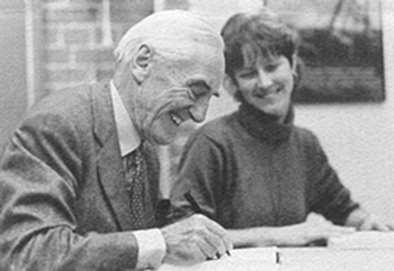
In 1995 the author Patrick O’Brian, then 80, and his wife Mary, travelled to the United States to promote his new Aubrey-Maturin novel, The Commodore. This was his second triumphal tour in two years to America. The piece below is extracted from The Patrick O’Brian Newsletter, Volume 4, Issue 2, published online as long ago as September 1995! The ‘agreeable on-stage interview’ at the Mariners’ Museum in Newport News referred to can be found on YouTube, and is well worth an hour of one’s time.
Our visit to America in 1994 had the happiest beginning, when the best and most elegant of young women received us and our belongings (we were standing in the wrong place and at the wrong carrousel in a rapidly emptying night-bound airport in New York), but this one did not start quite so well. Indeed, bewildered, slow-footed and misguided we missed our connection at Washington entirely, though our bags travelled on by themselves. There was no other plane for Charleston that night, so we were obliged to take a cab. It was driven by a Turk who had not been in the country long enough for a perfect mastery of the language; and since my Turkish would never recommend me anywhere our conversation soon languished. Yet it lasted long enough for me to suspect that he was driving in the wrong direction. “Charleston is in South Carolina, you will recall,” I said after ten miles of pondering.
“South Carolina?” asked the Turk. “Where him?”
“It is below North Carolina,” I said: but as this was the sum total of my knowledge I suggested that he might pull off at a garage for more expert local advice. Here they wrote down the numbers of the roads for him, and so we travelled on and on and on, stopping now and then for coffee and chicken sandwiches: it was in one of these places, at three in the morning, that I first heard a black-billed cuckoo. Even greater delights were in store. At dawn we found my editor at his family’s country house, and when we had recovered somewhat he showed us not only the Carolina wren, some cardinals, a prothonotary warbler, a pileated woodpecker, but two most improbable birds that I had always longed to see, the anhinga and the skimmer. I shall not mention the green-backed heron, the blue-winged teal or the pied-billed grebe for fear of growing tedious, but I cannot in decency omit the two young (and wholly black) bald eagles who returned to their wrecked nest just as we pulled in to lament their absence.
Then, when we were entirely restored, we went on to the great naval station at Norfolk, where the flag-officer commanding not only the American nuclear submarine flotilla but also that of NATO (surely the most powerful sailor known to man) entertained us, made my wife an honorary member of the force, and showed us USS Hampton, the latest, most beautiful, most lethal unit in his command.
On to the Mariners’ Museum at Newport News and an agreeable on-stage interview with the chief (so much better than a set speech or a reading) before a thoroughly intelligent audience; and to a luncheon party the next day at the Pentagon with a most hospitable and even more knowing group of admirals.
Then came New York and the splendid public library, where the librarian had laid out a remarkable exhibition of relevant books from his prodigious store (it included a work on the properties of the coca leaf by an eighteenth century Peruvian physician) and where Richard Snow and I conversed before a very large audience–very large, but scarcely intimidating at all, because of its evident benevolence.
The next day I lunched with the scientists of the Rockefeller University–what a pleasure it is to be praised by very highly intelligent men–and then came a publication party aboard HMS Rose, perhaps a little overwhelming, but they comforted me with a bottle of Veuve Cliquot and I was allowed to fire the evening gun.
Easter Day followed, and when our cab-driver had learnt from a colleague where Saint Patrick’s Cathedral was to be found we went there to a deeply moving Mass: people of all colours and a general unaffected piety.
Monday brought a radio interview of which I remember nothing, though my diary says “people telephoning in with questions, generally sensible, always kind.”
Tuesday saw us flying westward over an untroubled sea of cloud, quite unbroken until tea-time, when, peering down through rifts, we saw a black, thinly snow-covered landscape, possibly the Rocky Mountains themselves. On and on: eventually forest, watery plains, and then the undoubted Pacific and San Francisco, bounded by curious rectangles (mud? shallow water?) of purple, brown, light green.
Another television interview next day and then a session with that most amiable of modern poets, Robert Hass, now crowned with laurel.
Thursday was a holiday, and we sped over the Golden Gate Bridge (all that I had hoped for and more) and beyond to a charming mudflat inhabited by fat contented seals and by marbled godwits, western grebe, western gulls and many another bird unknown to me, all pointed out by a dear young woman called Denise Wight with a spotter and a knowledge that would have made Audubon stare. Then more lagoons (Bonaparte’s gull at last) and on to a grove of redwoods, glorious trees soaring into the sky. Another television bout, and I remember that the technicians objected to the colour of my face, openly and without restraint. “We can’t do anything with a face that colour: oh no.” I could not but agree–I could not but allow a young person to paint it a more becoming shade–yet I did find this degree of candour a little wounding.
On Friday, carrying our lunch, we flew away to Portland, in the Oregon, a northern settlement. Our journey took us over some truly splendid isolated snowy peaks and a vast crater filled with a fine blue lake. At one point the air, the snow and the ground were all suffused with blue; and just before Portland the best peak of all emerged from white cloud–perfect sky above and beyond.
Breakfast with the independent booksellers of Oregon, an intelligent set who really understood what breakfast meant, and then away to Los Angeles. Here we were lodged in splendour (hummingbirds in the jacaranda) in the Beverly Hills, where we were to dine with a film magnate. As a magnate he was a disappointment–no diamonds, no top-hat, no cigar–and there was nothing to distinguish him from any other highly civilized man except that he was kinder and more welcoming than most: but the dinner was singularly magnificent–I have never drunk better claret–and the company, which included some of our old friends, matched it.
Now came the long-expected Mojave Desert. How shall I attempt to describe it? A prairie-dog on its outer edge, as upright and curious as a meerkat, watching us intently; then an undulating landscape sparsely inhabited by outcropping rock, by that grim vegetable the Joshua tree, of two minds whether it should be a cactus or a scaley pine, and, thanks to a recent shower, by myriads of tiny, brilliant flowers. And there were gopher-holes by the hundred, and tracks in the sand, and colonies of a moderately interesting ant. But the promised rattle-snake did not appear; the very few birds that were not crows dived behind rocks before I could reach my binoculars; and my wife, venturing upon a long sandy slope that others had declined, came back destroyed, dehydrated. Nor was there a single burrowing owl. The Mojave Desert, though delightful, left much to be desired.
I shall leave the marvellous Los Angeles tar-pits, with their imperial mammouth (twelve feet at the withers, if I do not mistake), their two thousand Dire wolves and their primitive mulier sapiens with no remark other than a word of thanks to the young lady who gave up hours of her leisure to explain, among other things, the sabre-toothed tiger’s custom of dislocating its lower jaw in order to attack the giant ground sloth with greater effect: but I will observe that in tours of this kind, where a writer and his wife travel together, the greater strain falls on her. To be sure, addressing several hundred people is something of a challenge; but by definition they are largely on one’s side (they would scarcely be there otherwise) and their friendliness carries one along. The writer’s trials are quite unlike the continually repeated anxiety of packing for a new destination, of struggling with the inherent malignancy of things and their tendency to get lost (we left all our travellers’ cheques in South Carolina, and my hairbrush), of pitching camp and striking it at dawn: it is not surprising, therefore, that Mary should have excused herself from yet another splendid Hollywood party and have lain long abed while my editor and I flew to Seattle, leaving her under the eye of my editor’s wife, staying in the same hotel, and of a dear medical friend.
The meeting in Seattle was as pleasant as could be, but when we telephoned Los Angeles in the morning we learnt that weariness and dehydration had quite suddenly turned into pneumonia and that Mary had been taken off to the university hospital. I shall not dwell on this side of our tour except to say that the Los Angeles physicians dealt with the situation admirably, that the nursing was gentle and attentive, and that some days later we were able to take the plane for London–a direct flight–carrying with us an even stronger impression of that friendliness which seems to me one of the most outstanding qualities of the Americans.

 A Blog on the Ocean Wave