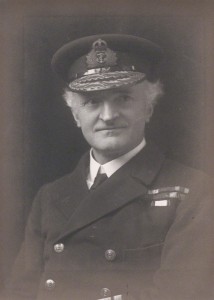
This morning I stumbled across a 7 September 1915 letter from Sir George A. Callaghan (Commander-in-Chief at the Nore) to Sir Frederick T. Hamilton (Second Sea Lord). In it Callaghan warns that perhaps a Lieutenant-Commander St. John should not have been given command of the Chatham Detention Quarters on account of his age (62). He did however recommend St. John being given the rank of Acting Commander and given charge of a new camp of huts. He goes on:
St. John was my lot in Britannia & retired 37 years ago! He is an excellent chap & it would soothe his feelings at being done out of his Detention Command if he was made Acting Commander.
The officer in question, the gloriously named William Charles St. Andrew St. John, had retired from the Navy on 4 July 1877, having only been promoted to the rank of Lieutenant on 30 January of that year. At this point he had been retired almost four times as long as he had originally been in the Navy (ten years)!
Evidently Callaghan thought St. John was up to the job despite his long absence from the Naval Service, and his thoughtfulness shines through in this letter to Hamilton, who was responsible for appointments. Suffice it to say St. John was given his Acting Rank.
In his unpublished memoirs Admiral of the Fleet Sir Henry F. Oliver mentioned a yarn from his early days afloat: ‘Achilles [an ironclad] paid off soon after I went to Sea, after years in commission, she had killed a man for every month she had been in commission by accidents aloft.’ This is a pretty wild claim, and fortunately one that does not appear to have been repeated elsewhere. Part of my first book (on the Royal Navy of the late 19th century) will examine how dangerous the twilight of the age of sail was, and Oliver’s statement is a good place to begin.
Possibly the most definitive record of numbers killed from accidents aloft would be the ship’s logs, which will presumably be at The National Archives, Kew. These are voluminous tomes however, and require a lot of effort to both photograph and then peruse. Casualty returns would have once been made, but I do not know whether these still exist. There are also a series of Statistical Reports (also rendered as Returns) on the Health of the Navy, which became an annual publication in 1856, which were conveniently printed by Parliament. They are a very handy tool, but are sometimes vague, depending on the year. Summaries are given for each specific station and two arbitrary statistical ‘stations’ called the ‘Home Station’ (incorporating all the Home Ports and Channel Squadron) and the ‘Irregular Force’, comprising ships on detached service or in transit.
Using the 1878 Statistical Report and an 1881 Navy List we can see Achilles was commissioned on 17 May 1877 at Devonport, and was recommissioned on 1 September 1880. Oliver, according to his service record, had gone to sea in the Agincourt on 23 July that year, so we know that he was telling the truth when he says Achilles was paid off shortly after he left H.M.S. Britannia. Looking at the various Reports we find that in 1877 Achilles suffered four deaths by violence (which incorporated drownings and falls from aloft), and six in 1878. There were nine deaths in total aboard the ship in 1879 but only four deaths in the whole Mediterranean Squadron on account of falls aloft, so the number of deaths in Achilles from aloft must be four or less. In 1880 there were five deaths in the ship, but for some reason these are not divided by old or new commission, which is normally the case. The ship was therefore served a 39 and a half months’ long commission, but at the very most could have only suffered 21 deaths (and likely several fewer, and how many of those were on account of work aloft one can only guess).
One conclusion is clear – Oliver’s claim that that Achilles had killed a man aloft for every month of her commission is clearly untrue. In his defence, however, he was writing over 60 years after the fact (and lived until he was 100).
As some will have no doubt gathered, I’ve just returned from a trip to California to consult the papers of Arthur J. Marder. One of the first items I looked at in my three and half days in the archive was a letter from Admiral Sir Lionel G. Preston, who served as Director of Minesweeping at the Admiralty in the First World War. The letter was dated 9 May 1953, and was addressed to long-time Marder correspondent Admiral Sir William M. ‘Bubbles’ James, who was in charge of N.I.D. 25, or ‘Room 40’, from 1917 onwards. Preston’s letter deals mainly with various tricks designed to fool the Germans, including publishing fake pamphlets showing mine-swept channels and Admiral Sir W. Reginald ‘Blinker’ Hall, the then Director of Naval Intelligence, selling them to enemy agents.
The most interesting aspect of Preston’s letter to me, however, is the following sentence:
Blinker allowed me to follow the doings of all minelayer Captains & so to judge their characteristics.
This, if true, is an interesting insight, although to what extent Preston or Hall could get into the minds of German minelaying captains is one for other historians to dwell upon perhaps.
Earlier in the letter Preston stated that he had interviewed the captain of U.C.44, Kurt Tebbenjohanns, who was captured when his minelaying submarine was sunk off Waterford on 4 August 1917. If he did interview Tebbenjohanns, was he the man responsible for the official interview, a transcript of which is in ADM 116/1513?
At any rate, Preston appears to have been the source for the claim made by James in his biography of Hall (The Eyes of the Navy, 116) that UC.44 was tricked onto an unswept German minefield, writing:
Our Q code had become compromised. I suggested we left some mined entrance left uncleared, knowing the regularity with which the ‘U’ boat returned to his beat.
Waterford was chosen, & DNI informed Luigi [Sir Lewis ‘Luigi’ Bayly] (C in C Queenstown) who agreed to secretly closing the port for at least a fortnight from the date the mines were laid.
Robert Grant has called this version (which was repeated by Beesly in Room 40, 265) into doubt, suggesting that U.C.44 was sunk by one of her own mines (Grant, U-Boat Hunters, 54-55). As Preston himself admitted in his letter to James, ‘I wish I could enlarge but time has blotted most of the names’.
Note: Quite why James gave the actual letter to Marder rather than a copy is a mystery to me. I would not give any of my correspondence away!
In The Rules of the Game Andrew Gordon cites the example of Rear-Admiral Leicester C. Keppel as an example of the ‘opportunities for action, adventure and sudden death available to personnel on remote stations, far away from the main fleets, in the middle years of Victoria’s reign’. He then cites Keppel’s entry in Who’s Who, which is certainly interesting. Gordon then goes on to write:
The details of this much skirmished officer’s later career become vague, suggesting that some recurring illness, or alcoholism, may have precluded further promotion; but greater (and less deserved) honours might have come his way had he had the good fortune to serve in safe, glamorous flagships rather than remote, treacherous backwaters.
So in the space of a few lines Gordon insinuates an officer might have been a drunk or an invalid, and damns all flagship officers as unworthy of any rewards.
If he’d actually bothered to study the career of Keppel, and understand the mechanics of promotion in the Royal Navy, a different picture emerges. Keppel received his promotion to Commander (at the relatively young age of 32) from his uncle, Admiral The Hon. Sir Henry Keppel, in a haul down vacancy on the China Station. This system was notorious because Commanders-in-Chief could promote their relatives over the heads of dozens, if not hundreds, of their contemporaries, in the almost-certain knowledge that the Admiralty would confirm their selection (despite repeated attempts to abolish it, exceptions continued to be made as late as 1908, if not later). So much for undeserved honours.
As to Keppel’s later career, he held two appointments during the 1870s as a Commander: the first in the Coast Guard (an immediate reserve for the Navy as well as a coast-watching service) and then in the screw gunvessel Avon on the West Coast of Africa. His services there apparently merited his selection for promotion to the rank of Captain in 1880. But despite his uncle obtaining his promotion to Commander in 1869, his ten years spent in that rank meant that he could never rise any higher, contrary to Gordon’s claim. Keppel was placed on the retired list on reaching the age of 55 on 27 August 1892, as per the regulations. Promotion from Captain to Rear-Admiral was by seniority. When he retired there were still 29 Captains above him on the list. The next above him, Arthur K. Wilson, wasn’t promoted until 20 June 1895. Keppel’s career wasn’t a victim of illness or alcoholism, as Gordon would have it. If he was indeed a victim, then it was of the system as it then stood.
Thanks to the joy that is the #PetsOnShips hashtag on Twitter, one often sees photos of cute animals in a maritime setting. In my own research on the 19th century Royal Navy I’ve found mention of cats, dogs, and a surprising number of bears, all kept as pets on board British warships. All manner of other creatures, great and small, have been documented as going to sea (some, sadly, staying there!).
As far as the Royal Navy is concerned the end of pets on ships began on 4 May 1975, when all cats were ordered to be landed during a rabies epidemic sweeping Europe. Over continued health fears, in October 1977 the end came for the rest of the Fleet’s pets. Pictured is the Royal Navy’s last sea going dog, Muttley, apparently rated Ordinary Sea Dog.
In his influential book Sir John Fisher’s Naval Revolution Dr. Nicholas Lambert refers (p. 245) to a November 1911 ‘secret rendezvous at Plymouth Dockyard’ between retired Lord Fisher, a former First Sea Lord, and Winston Churchill, the new First Lord of the Admiralty. In my article on Fisher and Churchill’s 1911 correspondence (Harley, ‘“It’s a Case of All or None”: “Jacky” Fisher’s Advice to Winston Churchill, 1911’, The Mariner’s Mirror, 102:2, 186), I described Lambert’s choice of words as ‘a touch melodramatic’, as both were present at the launch of the battleship Centurion at Devonport Dockyard on 18 November. Arthur Marder rightly described the meetings as secret insomuch as they ‘did not appear in the newspapers’ (Marder, Fear God and DreadNought, II, 401).
In Lambert’s defence, last year (after several unsuccessful attempts) I was able to consult the visitors’ book of H.M.S. Enchantress, the Board of Admiralty’s yacht. Fisher’s name does not appear in it for that weekend, although this is by no means proof of any kind of conspiracy to suppress knowledge of any meeting which may or may not have taken place on board.
Quite why any secret meeting would need to take place is another question. As Lambert states, and I illustrate quite clearly in my article, Fisher and Churchill were corresponding nearly every day, and had spent a weekend together only a few weeks previously. The final nail in the coffin of any notion of a ‘secret rendezvous’, however, is the above photograph of the two apparently arriving at the launch of Centurion, which I only came across last week (despite its caption, it has been lazily dated by Getty Images to 1 January 1911). From left to right are George Lambert, Civil Lord of the Admiralty (a stalwart supporter of Fisher); Lord Fisher; Winston Churchill; Rear-Admiral Ernest Troubridge, Churchill’s Private Secretary (whose prematurely white hair earned him the name of ‘the Silver King’). If this is a secret rendezvous then I shudder to think what a non-secret one would look like.
In November 1888 Ernle Chatfield, Midshipman, was appointed to the sloop Cleopatra, which had just commissioned for duty on the South East Coast of America Station. He recalled in his memoirs of her Captain:
Captain Archibald Musgrave was an elderly, grey-bearded man with a large growth on the back of his neck.
Chatfield went on to recount how on Christmas day the ship was taken aback without warning, keeled over, and on account of the First Lieutenant’s swift response the ship keeled over in the other direction:
The Captain, flung off the poop, struck his bad neck against a bolt and was carried away insensible to his cabin. He soon recovered, but I think the blow eventually killed him as he died at Monte Video in the following year.
Lord Chatfield can not have thought too much of Musgrave, as several of his details are wrong. His name was Archer John William Musgrave, not Archibald. He had entered the Royal Navy in 1855 and, in spite of losing a year’s seniority as a Midshipman, he had managed to obtain a haul down promotion to the rank of Commander at the age of 28, and promotion to Captain at the relatively early age of 37. He then had to wait over five years for a command, that of Rapid, before being given command of the Cleopatra in 1888. He was not elderly, being only 46 at the time, although if he was as grey-haired as Chatfield says then he may be forgiven for assuming it. Where Chatfield is especially inaccurate is in claiming Musgrave died in Montevideo in 1889. On 10 August 1891 he was superseded at his own request (Chatfield had left the ship in February 1890), and was invalided on 21 August for ‘Lipomata’, the growth on his neck. He returned to Britain on 21 September and was invalided, his ailment being ‘beyond control’. He then presumably went abroad for his health, and he died in Pau, France, on 20 May 1892, 13 days after his fiftieth birthday. His widow, Louise Elizabeth Innes Musgrave, was awarded a pension of £90 a year. In highlighting Captain Musgrave’s sad story, Chatfield might have gotten the facts right, a record which is now corrected.
Captain Musgrave’s service records are in ADM 196/14/461 and ADM 196/37/282.
In August 1933 Captain Thomas H. Binney gave up command of H.M.S. Hood in the Home Fleet. His immediate superior, Rear-Admiral William M. James, commanding the Battle Cruiser Squadron, wrote of him, ‘I have used the highest marking throughout, because I do think that Captain Binney is an exceptional officer.’ He then went on to go into detail about Binney’s success in command of the Hood in the wake of the Invergordon Mutiny.
Then the Commander-in-Chief of the Home Fleet passed judgement. We have already seen how blistering Sir John D. Kelly could be in writing about his subordinates. In this instance he was by and large positive, yet still couldn’t resist some amusing observations and also a back-handed compliment at Rear-Admiral James:
Though I have the highest opinion of Captain Binney, I should not have marked him quite so superlatively throughout.
Exuberance is, however, one of the pleasant idiosyncracies of his reporting officer.
A first-rate Captain of a ship. His leadership had made a vast difference in the Ship. Though there was a lot of back-lash to make up, she has paid-off a thoroughly efficient fighting unit of my Fleet. On account of the back-lash aforesaid, I do not consider that HOOD reached the pinnacle that she should have in a further six months under his Command.
A delightfully loyal, most thorough and most reliable Officer.
He is active and young for his years, though I believe him to be the worst Golfer in England.
His sense of the ridiculous is not readily apparent but, may be, it is latent in him.
I recommend him most strongly for promotion to and employment as a Rear-Admiral, and think he is likely to go far in the higher Ranks.
Whilst scouring my research material for data on sail drill competition in the Mediterranean (which I eventually found, thankfully) I came across the following description of the interior of the battleship Inflexible in a volume supposedly written by the royal princes Albert Victor and George (later King George V). It is dated 30 May 1882, and therefore pre-dates Inflexible’s participation in the bombardment of Alexandria less than two months later. The Captain Fisher referred to is, of course, ‘Jacky’ Fisher, later Lord Fisher. Fisher was allegedly criticised for the emphasis on preparation for battle illustrated here, and encouraged to excel in the fleet sail drill. As the photo of Inflexible makes clear, she was a ship torn between the past and future: a turret ship with rigged for sail. The following short account may prove of interest.
At 10 A.M. some of the Bacchante’s officers went at Captain Fisher’s invitation to see the Inflexible. He himself kindly explained everything. In the fore cabin we saw the large diagrams of the ship, and how each half of the ship is ‘double against the other,’ and how each fitting besides is in duplicate.
There are 6,000 tallies in the ship and everything is labelled: everything below is coloured red or green, for the port or starboard side, so that a man can never lose his way amid all the intricacies of the internal fittings, and can tell at once if he is going forward or aft. The compartments, too, are all numbered, and not marked with letters of the alphabet, so that you can tell at once how far distant you are from either end of the ship. Her stability is far better than that of the Duilio or Dandolo, or any of the similar French ships. Then we went round the ship; the electric light reflected below has the same effect as sunlight coming in through large ports in a ship’s side: we went into the turret and saw the guns raised, run out and in, and loaded by hydraulic gear. Captain Fisher explained how it was almost impossible for any accident to occur in any way whatever, on account of the system of double checks, so that it would almost require a regular plot to put all wrong.
I have written before about some of the bad history surrounding Room 40, and, now, another instance. In an article on the famed Zimmermann Telegram of 1917 BBC News reporter Gordon Corera writes, ‘On the morning of 17 January 1917, Nigel de Grey walked into his boss’s office in Room 40 of the Admiralty, home of the British code-breakers.’
Corera was referring to Rear-Admiral W. Reginald ‘Blinker’ Hall, Director of the Intelligence Division of the Admiralty War Staff (pictured). In that one sentence, however, he has made a number of errors.
Hall was not de Grey’s boss. As the latter himself admitted, technically his boss at the time was Sir J. Alfred Ewing, the Director of Naval Education.
Hall’s office was not in 40 O.B., which was on the first floor of the Old Building of the Admiralty complex. Using the Admiralty Telephone Exchange List for May 1917 we see that his office at the time was in 39A (where it had been since he took up the post in 1914) on the ground floor of Block I , later renamed West Block. Some time between May 1917 and February 1918 Hall moved into 39 West Block, a much larger room.
De Grey is hardly likely to have just ‘walked’ into Hall’s office. Corera quotes only part of his recollection in his article, but de Grey went on, ‘I was young and excited and ran all the way to his [Hall’s] room’, which makes far more sense if the office was a whole block away, rather than in the suite of rooms the code-breaking team occupied in and near 40 O.B.
As errors go, it is difficult to see how they can have originated from the existing literature, poor as it is. So come on, BBC News: up your game, please.
Sources
Admiralty Telephone Exchange List. Admiralty Library, Portsmouth.
Batey, Mavis. Dilly: The Man who Broke Enigmas (London, 2009).


 Thanks to the joy that is the