A Titanic Fluff Up

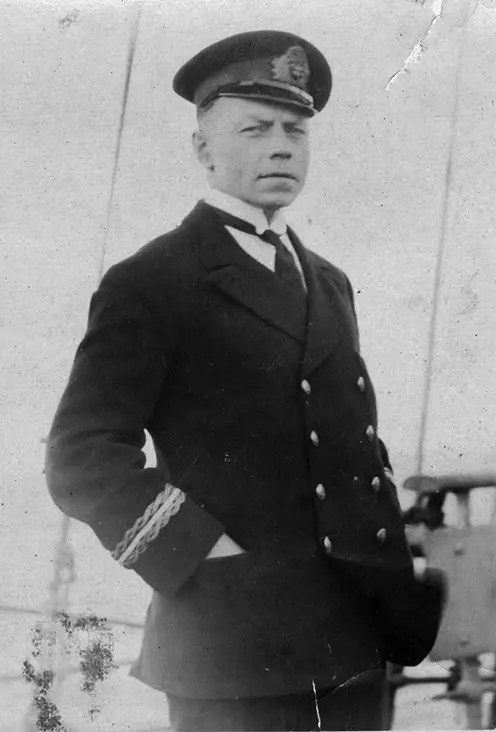
Herbert John Pitman (1877 – 1961) was Third Officer of the Titanic on her final voyage. I stumbled across his Wikipedia article yesterday and was struck by a number of things. One is the photo: he has a white stripe between his gold braid, which I thought was slightly odd for a Third Officer. In the Royal Navy a white stripe or insert signified the Accountant Branch, and for the merchant service it was the same: apparently after surviving the Titanic disaster Pitman transferred to the purser line because of colour blindness, which must have been a cruel blow to a man in his 30s.

In his infobox it was claimed that he was an Acting Paymaster who served in the Royal Naval Volunteer Reserve from 1916 to 1919. In the text it stated: ‘During World War I, Pitman served aboard troop transport ships, notably aboard RMS Teutonic as Assistant Paymaster. In 1916, he received a commission as Lieutenant in the Royal Naval Volunteer Reserve and served as Stores Officer aboard a destroyer. In 1919, he was demobilised and returned to the Merchant service.’

Perhaps unsurprisingly, this is all drivel. Mercantile marine officers, because of their actual professional experience, usually became officers in the Royal Naval Reserve, and not the Royal Naval Volunteer Reserve. Pitman was no different, becoming an Temporary Assistant Paymaster in the Royal Naval Reserve on 12 September 1914. At some point in 1917 he became an Acting Paymaster, which at the end of 1918 was renamed Paymaster Lieutenant. He spent the entire war in the Teutonic, so I fail to see how he could have been in destroyers. He was still on the list of RNR officers in April 1919 but disappears by July. Perhaps because of the wartime nature of his service he has no digitised service records at The National Archives.

Naturally, this crime against history has now been fixed.

What’s in a name?

Fighters Over the Fleet: Naval Air Defence from Biplanes to the Cold War:  Amazon.co.uk: Friedman, Norman: 9781591146162: Books

I may have ranted before on 𝕏 about Norman Friedman’s complete lack of attention to detail when it comes to Admiralty administration in his many, many books. He may well have a perfect understanding of it, but the way he presents it in print is misleading at best. And so the other day I looked at his 2016 Fighters over the Fleet: Naval Air Defence from Biplanes to the Cold War for the first time. The first chapter opens with the Royal Navy on page 11. These are some of the errors on that page.

‘During most of the period covered by this book, the Royal Navy was administered by a five-man Board of Admiralty headed by the First Sea Lord.’ Utter nonsense. The Board of Admiralty was headed by the First Lord of the Admiralty, a politician, and not the First Sea Lord. The last time there had been five men on the Board of Admiralty was in early 1882. The number would never fall this low again whilst the office of Lord High Admiral was in commission (which ended in 1964). If (and one is being extremely charitable here) he was thinking of naval officers on the board given his First Sea Lord claim, then there were five for two periods in the 20th century: four months in 1917, and six years between 1929 and 1935. Hardly ‘most of the period covered by this book’.

‘In theory, the materiel departments of the navy, the Department of Naval Construction (DNC), the Department of Naval Ordnance (DNO) and Engineer-in-Chief (propulsion) met the Staff Requirements and supervised the acquisition of ships and weapons. DNC (the same letters are used for the Director of Naval Construction) was, for example, responsible for aircraft carrier design, which in turn set the limits within which British naval aircraft were built.’ There was never a Department of Naval Construction. There was the Naval Construction Department, also known as the Department of the Director of Naval Construction. Likewise there was never a Department of Naval Ordnance. There was a Naval Ordnance Department, also known as the Department of the Director of Naval Ordnance. These departments and their directors were subsumed into new departments in 1958.

‘Before the First World War, a new Department of Naval Aircraft was created, headed by the Director of Naval Air Division (DNAD);’ No. An ‘Air Department’ was founded under a ‘Director of Air Department’ in 1912. An Air Division of the Naval Staff existed in 1918 and 1919. Its duties were then vested in the Royal Air Force’s liaison officer to the Admiralty, then the Tactical Section of the Naval Staff, and from 1920 an Air Section. This finally became the Naval Air Division, under a Director, on 31 December 1928.

Most of these details are in the archival material which he has looked at, and it simply beggars belief that he is incapable of copying it faithfully. With regards to the Board of Admiralty, one can only marvel at his ignorance.

Rank Dishonesty

Fitch wearing army uniform with naval cap and khaki cover. He wore the rank insignia of a major.

Yesterday my attention was diverted to Admiral Sir Ernest Troubridge and his service in Serbia during the First World War. I knew there had been some writing on the subject so I had a good Google to see what I could find. It turns out that a man named Charles E. J. Fryer evidently cornered the market on the subject in the 1980s and 1990s, writing an article in The Mariner’s Mirror and two monographs. I had a glance through them, and immediately noticed some peculiarities with regards to references to a member of Troubridge’s staff.

‘Together with his secretary, Lieutenant-Commander Henry Fitch’ (‘The Watch on the Danube’ (1987), p. 302); ‘ In addition there were Lieutenant-Commander Henry Fitch, whom Troubridge selected to be his Secretary and Paymaster from among the company of his former flagship, the Defence’. ‘Henry Fitch, six years Kerr’s junior, joined the Navy in 1909, and was a Sub-Lieutenant in the Defence‘ (The Royal Navy on the Danube (1988), p. 55); ‘his secretary, Lieutenant Henry Fitch’ (The Destruction of Serbia (1997), p. 116).

Henry Maldon Fitch did indeed join the Service in 1909 (his service record is held by The National Archives). In 1914 he was not a Sub-Lieutenant in the Defence: He was a member of the Accountant Branch and held the rank of Assistant Paymaster. With less than four years’ service in that rank he had the relative rank of Sub-Lieutenant. When Troubridge selected him to be his Secretary (not ‘Secretary and Paymaster’) his uniform suddenly became a lot brighter: under the regulations, as a Secretary to a Flag Officer who was not a Commander-in-Chief held the relative rank of Lieutenant-Commander! He went from one stripe of ½ inch gold lace (with the Accountant Branch’s white stripe) to two and a half at the age of 23.

Fryer must have known from reading the source material that Fitch was not a Sub-Lieutenant, a Lieutenant, or a Lieutenant-Commander, yet still wrote it anyway. That the editor of The Mariner’s Mirror or his peer reviewers (if they had them back then) didn’t catch it is absurd. It is not helped that Fitch wrote in his memoirs of the elevation to Secretary, ‘It meant a sudden jump from one to two and a half stripes—from the rank of Sub-Lieutenant to that of Lieutenant-Commander, missing out the rank of Lieutenant altogether.’ (Fitch, My Mis-Spent Youth, p. 126) Fitch himself would have known damned well he wasn’t a Military Branch officer and didn’t hold Military Branch ranks. C.V. inflation is nothing new!