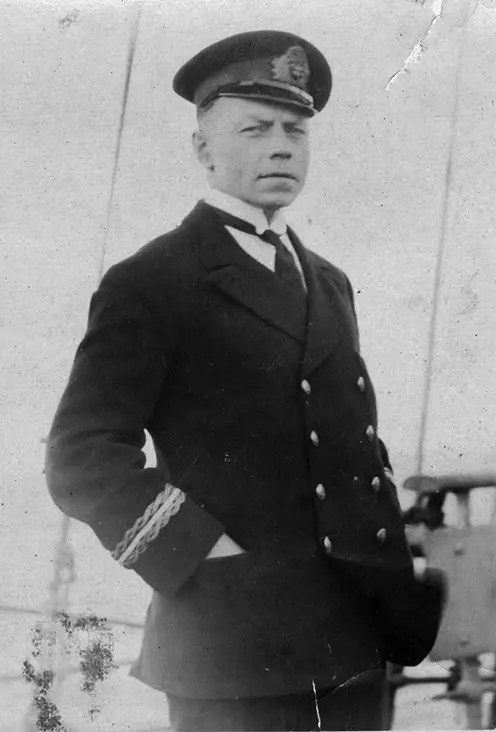
Herbert John Pitman (1877 – 1961) was Third Officer of the Titanic on her final voyage. I stumbled across his Wikipedia article yesterday and was struck by a number of things. One is the photo: he has a white stripe between his gold braid, which I thought was slightly odd for a Third Officer. In the Royal Navy a white stripe or insert signified the Accountant Branch, and for the merchant service it was the same: apparently after surviving the Titanic disaster Pitman transferred to the purser line because of colour blindness, which must have been a cruel blow to a man in his 30s.
In his infobox it was claimed that he was an Acting Paymaster who served in the Royal Naval Volunteer Reserve from 1916 to 1919. In the text it stated: ‘During World War I, Pitman served aboard troop transport ships, notably aboard RMS Teutonic as Assistant Paymaster. In 1916, he received a commission as Lieutenant in the Royal Naval Volunteer Reserve and served as Stores Officer aboard a destroyer. In 1919, he was demobilised and returned to the Merchant service.’
Perhaps unsurprisingly, this is all drivel. Mercantile marine officers, because of their actual professional experience, usually became officers in the Royal Naval Reserve, and not the Royal Naval Volunteer Reserve. Pitman was no different, becoming an Temporary Assistant Paymaster in the Royal Naval Reserve on 12 September 1914. At some point in 1917 he became an Acting Paymaster, which at the end of 1918 was renamed Paymaster Lieutenant. He spent the entire war in the Teutonic, so I fail to see how he could have been in destroyers. He was still on the list of RNR officers in April 1919 but disappears by July. Perhaps because of the wartime nature of his service he has no digitised service records at The National Archives.
Naturally, this crime against history has now been fixed.


