Taken from the August 2026 issue of the Bugle, the newsletter of the Wikipedia Military History Project.
I have recently come to the conclusion that there is something rather rotten at Seaforth Publishing. For every good book that they print, such as Andrew Boyd’s Naval Intelligence Through the Twentieth Century, they seem to publish one or more howlers. Earlier this year there came a biography of Admiral Sir Reginald Bacon which, they claimed, “does justice” to the man and his work.[1] Remarkably, the author of that book did not mention, let alone reference, Bacon’s private papers at Royal Navy Museums: Portsmouth, which have been there since 2018. Instead we were treated to a panoply of secondary and published primary sources, with a relatively limited amount of archival research. Perhaps it’s just me, but to ignore the papers of a biography’s subject is utterly embarrassing, whatever the reason.
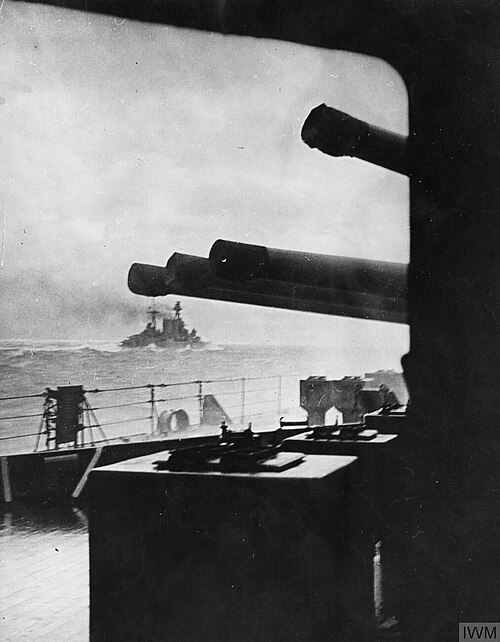
That disappointing work leads me to Last Resting Place, sub-titled The Loss of HMS Hood and other Capital Ships 1939–1945, by Martin Lawrence. I first heard inklings of it years ago when the author gave a lecture to RINA (which as far as I am aware has not been published) and an interview to History First in 2023.[2] Lawrence claimed that the catastrophic loss of the British battle cruiser Hood on 24 May 1941 was caused by mechanical failure rather than German shell. Certainly a controversial theory, by that point apparently based on 12 years of research.
Fast forward to 2025, and Seaforth had evidently agreed to publish Lawrence’s research with a publication date of 31 August. However, when the end of August rolled around the date was pushed back to 31 March 2026. Come March the date was pushed back a second time, this time to 30 June. Towards the end of June I put an order in, and lo, and behold, on 30 June it was delayed a third time, until the end of July. Not long afterwards the publication date was altered a fourth time on 3 July and published. One has to wonder at so many delays. They certainly did not make for a better book.
As the sub-title indicates, Last Resting Place is an examination of the ten British capital ships (battleships, battle cruisers and aircraft carriers) lost during the Second World War, divided into three parts: ships sunk by gunfire (Glorious and Hood), sunk by torpedo (Courageous, Royal Oak, Ark Royal, Barham, and Eagle), and sunk by aircraft (Prince of Wales, Repulse, and Hermes). There is a final chapter, “The Audit of British Capital Ships 1939–45”, and two appendices, entitled “Glorious – What if She Had Had a Swordfish Aloft?” and “The Course and Track of Devonshire to Scharnhorst and Gneisenau”.
The bibliography consists of three and a half pages: two of books; one of archival material from The National Archives (never actually stated, and erroneously referred to as “the National Archive” in the Introduction); and half a page of websites (chiefly those of the survivors’ associations, to whom the book is dedicated). When I say books, I mean books: no articles are listed, which means, for example, no mention of Warship International and its wealth of material, with a corresponding absence of the names of Jurens, Garzke and Dulin on the topic of Hood. Missing from other journals is James Levy’s 2000 article on the loss of Glorious, to name one. There are no footnotes or endnotes. This is extremely surprising given that, in the words of the blurb, “In ten chapters the author dissects what happened to these fine ships, how their losses came about and where their wrecks are located; and he looks in detail at theories, causes and conclusions surrounding the sinkings.”[3] Without evidence any conclusions are automatically suspect, and judging by the bibliography alone Lawrence hasn’t looked in detail at much of anything.
Each chapter follows a set pattern: a history of the ship involved, and then an account of its loss. The ship histories are far too long, and if nothing else could have been restricted to technical details with direct relevance to the ship’s loss. This highlights a major problem with the book: its editing, or lack thereof. For example, the mining of Queen Elizabeth and Valiant in Alexandria harbour in 1941 is mentioned no fewer than six times. The final chapter, “The Audit of British Capital Ships 1939–45”, isn’t really an audit at all. The two appendices, 17 pages and four pages long respectively, are in fact miniature essays, and should either have been culled or incorporated into the Glorious chapter.
The battle cruiser Hood has the longest chapter out of the nine on losses, some 50 pages out of 174 (over a quarter). It takes us over 12 pages to get to the Battle of Denmark Strait. Having outlined and criticised the proceedings and conclusions of the boards of inquiry, Lawrence informs us that a possible cause of Hood’s loss was “mechanical failure”: specifically a failure of a propeller shaft bearing:
If somehow a shaft broke out of its mountings then, by flailing about, it was certain to smash against the magazine’s steel walls and cause a shower of hot sparks that could immediately ignite some of the bags of cordite stored there.
Lawrence believes that flames near the mainmast and the timings involved support such a conclusion, but the main cause, given twice (more poor editing), was the evidence of a survivor from Hood:
In among the witness statements at the second inquiry was one from Able Seaman Robert Tilburn, who in his recollections of the event said that after Bismarck’s second salvo landed close alongside, towards the stern of Hood, “the ship was shaken with a great vibration”. His words were overlooked and never given even a second glance, but this statement offers a significant indication of something going wrong deep in the ship.
The principal problem with this argument is that I cannot find “the ship was shaken with a great vibration” quotation attributed to Tilburn in his evidence to the second board of inquiry.[4] Neither Google nor Google Books recognise the quotation. The lack of any sort of referencing means that the claim, if it exists, cannot be verified. Claiming that this statement was overlooked looks cavalier (a polite term) when its existence cannot be proved. Further, no definition is provided for “vibration”. Shocks, which may or may not be the same as vibrations, were frequently associated with hits at the Battle of Jutland.
Is Lawrence’s imaginary quotation anchored in reality? Sort of. At the second inquiry Tilburn was asked, “Can you tell us any more about the final hit?” (emphasis added). He replied “There was just a tremendous vibration and the debris falling down.”[5] If one is being extremely generous, one can presume that Lawrence somehow bastardised this quote and took it completely out of context.

The Hood chapter, and its novel theories, was clearly the raison d’être of this book, as Lawrence doesn’t seem to have looked too hard into the fates of his other subjects. The actual sinking of Barham, for example, receives half a page, with the unsatisfactory conclusion “a colossal explosion tore the hull apart as presumably internal fires ran out of control and triggered off a main cordite magazine at the stern of the ship”. The history of the ship leading up to the sinking runs to nine pages.
The author does occasionally show flashes of inspiration. On the subject of the competence of Glorious‘ captain, Guy D’Oyly-Hughes, he provides a table showing the age and seniority of the 20 captains of British battleships, battle cruisers and aircraft carriers in May 1940, demonstrating that his holding the command wasn’t out of the ordinary. Given there were over 250 captains on the active list at the time, it shows the faith that the Admiralty had in D’Oyly-Hughes. However, I recently typed up a lot of his service history for The Dreadnought Project based on his service records, and it is clear that while the man was talented he had some character flaws.[6] Further research that I have done this past week in the papers of Captain Stephen Roskill (apparently ignored by Levy and the likes of Tim Slessor) suggests that D’Oyly-Hughes was not just a shit of a human being but utterly mad by the time of the sinking, which had a direct bearing on the loss of Glorious, Ardent and Acasta.
In other ways, this is a very odd book, riddled with details which are at best irrelevant and at worst stupid. Writing about newer British aircraft carriers he refers to the Implacable as “the first of an enhanced and larger design, now with four propellers”. We are never informed of the significance of the number of propellers, especially since the number of shafts on earlier carriers isn’t specified! Is the reader meant to be impressed? Apparently the wreck of the Bismarck was discovered in the “western Atlantic”. He writes “In terms of fighting equipment, in the broadest sense, and being designed and built in Britain, Hood was perhaps only ever equalled by the very elegant but massively powerful TSR2 supersonic strike and reconnaissance aircraft.” Because of this very, very dubious assertion we are treated to a photograph of TSR-2! Funnily enough, about the only good thing which can be said about this work is that it is well-illustrated.
The publisher’s promotional material for the book concludes, “It is a fascinating compilation for anyone interested in the history of the Royal Navy’s great capital ships and sheds genuine new light on the calamitous destruction of nearly half of them during the War.” It is fascinating, but not for the reasons all concerned may desire. Frankly Seaforth should be ashamed to publish such lightweight material as this. As for Lawrence, he ought to have submitted his sensational theories to a peer-reviewed journal or to a publisher which actually vets its works. No doubt someone will argue that it is a “gateway” to the subject of British big ship losses in the Second World War. It can not be treated as such because of its poor writing, built on poor research and sourcing. An interested student of history would be better off printing off relevant Wikipedia articles (which reflect a much higher standard of scholarship).
Last Resting Place cannot in good conscience be recommended to anyone.
Post script: While writing this essay, I came across regular Seaforth author David Hobbs’ review for the Australian Naval Institute. Having identified many flaws in Last Resting Place he concluded that it was “disappointingly lightweight” (I had already used “lightweight” before I saw he had), and “I do not recommend it to my fellow ANI members.”[7]
Footnotes
- “Admiral Sir Reginald Bacon”. Pen & Sword Books. Retrieved 5 August 2026.
- Bridge, Mark. “HMS Hood ‘sunk by mechanical failure, not Bismarck’”. History First. Retrieved 5 August 2026.
- “Last Resting Place”. Pen & Sword Books. Retrieved 5 August 2026.
- QQ. 15–86. The National Archives (TNA), ADM 116/4351, ff. 359–364.
- Q. 72. TNA, ADM 116/4351, f. 363.
- Harley, Simon. “Guy D’Oyly-Hughes”. The Dreadnought Project. Retrieved 5 August 2026.
- Hobbs, David. “Last resting Place. The loss of HMS Hood and other ships”. Australian Naval Institute. Retrieved 31 July 2026. Incidentally, Hobbs also reviewed Craddock’s life of Bacon for the ANI. His review contains a number of errors and doesn’t address the book’s lamentable referencing. Unsurprising conclusion: “I thoroughly recommend it.” Hobbs, David. “Driving Change in Naval technology 1900-1918”. Australian Naval Institute. Retrieved 31 July 2026.
Publishing details: Lawrence, Martin (2026). Last Resting Place: The Loss of HMS Hood and other British Capital Ships 1939–45. Barnsley: Seaforth Publishing. ISBN 9781036133313.

